
 English
 Español
 Deutsch
Buying separate rainwear for each outdoor activity gets expensive. A single loose raincoat that performs across different settings offers better value. The question is whether one design can handle hiking, fishing, concerts, and cycling without compromising too much in any area.
Hiking demands freedom at the shoulders
Trail movement is not linear. Hikers twist, reach, and climb. A loose raincoat for hiking must allow full arm rotation without riding up.
The shoulder area matters most. When you raise trekking poles or grip a rock hold, a loose raincoat should shift with your body rather than pulling tight. Look for raglan sleeves or kimono-style cuts that eliminate the underarm seam. These designs let a loose raincoat move naturally with the shoulder blade.
Hiking also involves a pack. A loose raincoat needs extra length in the back to cover the lumbar area when leaning forward. Many hiking-specific models add a dropped rear hem. Without this, a loose raincoat exposes the lower back during steep ascents.
Fishing requires long-duration comfort
Anglers stay out for hours. A loose raincoat for fishing prioritizes different features than hiking gear.
Ventilation becomes critical. A loose raincoat worn for three hours traps body heat. Look for underarm eyelets or back mesh panels. Some loose raincoat models include zippered vents along the side seams. These release warm air while keeping rain out.
Pockets matter for fishing. A loose raincoat should have accessible chest pockets for leaders, pliers, and small tackle. Handwarmer pockets at the sides are useful for cold mornings. Check that pocket openings face upward or have storm flaps. Downward-facing pockets on a loose raincoat collect water.
The hood design differs from hiking. Fishermen look up at the sky frequently. A loose raincoat hood should have a stiffened brim that stays in place when you tilt your head back. Soft, floppy hoods on a loose raincoat become useless in this scenario.
Concerts and amusement parks need speed
Entertainment venues are about spontaneity. A loose raincoat for these settings must deploy and pack away quickly.
Weight becomes a priority. A loose raincoat that lives in a day bag should not exceed 200 grams. Heavy material discourages people from carrying it. An unused loose raincoat provides no protection at all.
The packability of a loose raincoat matters here. Does it stuff into its own pocket? Does the folded size fit in a small crossbody bag? Venues with bag size restrictions require a loose raincoat that compresses to palm dimensions.
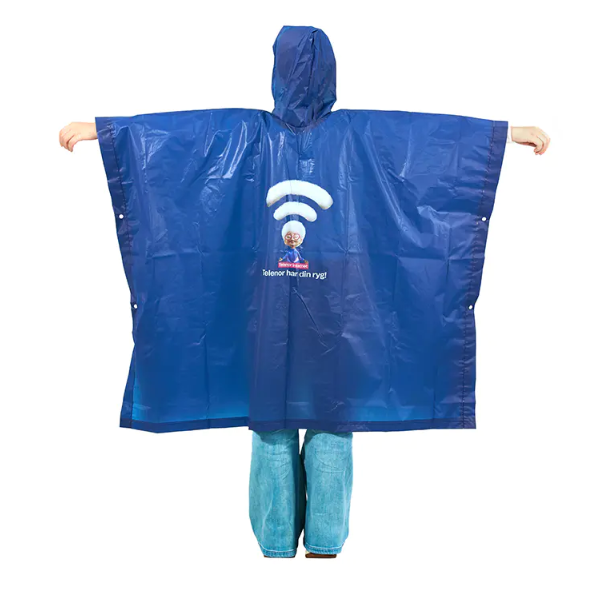
Clear or translucent loose raincoat options work well at concerts. Security staff can see what you are carrying underneath. A solid colored loose raincoat may trigger additional screening.
Group dynamics affect choice. If you attend with family or friends, a loose raincoat should be easy to put on and take off while holding a drink or phone. Two-way zippers help. You can open a loose raincoat from the bottom to access pockets without removing the garment.
Cycling tests the lower hem
Bicycle commuting puts unique stress on a loose raincoat. The forward lean position changes how the garment drapes.
The front hem of a loose raincoat should not catch on the top tube. Measure the distance from your waist to the bike frame when seated. A loose raincoat hem that falls below this point will snag when you put a foot down at stops.
Reflective details are non-negotiable for a cycling loose raincoat. Look for piping or strips on the sleeves and back. Moving cyclists need visibility from all angles. A dark loose raincoat with no reflective elements is dangerous at dusk.
Cuff design affects brake lever access. A loose raincoat with elastic cuffs works better than open sleeves. Loose material near handlebars can get caught in the brake lever gap. Some loose raincoat models include thumb loops that keep sleeves from sliding up during arm extension.
The rear hem on a cycling loose raincoat should extend past the saddle. Road spray from the rear wheel travels upward. A short loose raincoat leaves your lower back exposed to tire mist.
Matching thickness to use frequency
Material thickness determines durability and packability. A single loose raincoat cannot be both ultra-light and heavy-duty.
For hiking and cycling, a loose raincoat between 0.10mm and 0.15mm balances weight and tear resistance. This thickness survives brush contact and minor snags.
For fishing and prolonged outdoor work, a loose raincoat of 0.20mm to 0.30mm resists abrasion from seat edges and tackle boxes. The tradeoff is a larger folded size.
For concert and theme park use, a loose raincoat under 0.10mm prioritizes packability. These thin loose raincoat products are often disposable or single-season items. They handle light rain but tear easily.
The realistic expectation
No single loose raincoat excels in all four scenarios. A 0.12mm garment works acceptably for hiking, cycling, and packed as an emergency layer for concerts. For fishing durability, step up to 0.20mm and accept the bulk.
The best strategy is owning two loose raincoat products. A lightweight version for travel and daily carry. A heavier version for planned outdoor activities. Between them, one loose raincoat covers most needs year-round.
