
 English
 Español
 Deutsch
Rainwear has traditionally been heavy. Rubberized fabrics and thick PVC dominated the market for decades. A lightweight eco-friendly raincoat changes this pattern by using modern materials that reduce weight without sacrificing waterproof performance.
The shift matters for users who carry rain gear "just in case." A bulky coat stays in the closet. A compact alternative gets packed.
Material types that enable lightness
Several materials fall into the lightweight category. Each has distinct characteristics.
EVA is ethylene-vinyl acetate. It is soft, flexible, and contains no plasticizers. A lightweight eco-friendly raincoat made from EVA does not become stiff in cold weather. The material remains pliable across a wide temperature range.
PEVA is polyethylene vinyl acetate. It is chemically similar to EVA but with different processing characteristics. A lightweight eco-friendly raincoat using PEVA has a slightly different hand feel and drape.
Both materials are chlorine-free. This distinguishes them from traditional PVC rainwear.
Recycled polyester with waterproof coating is another option. A lightweight eco-friendly raincoat in this category uses fabric woven from post-consumer plastic bottles. The outer layer sheds water while the inner layer breathes.
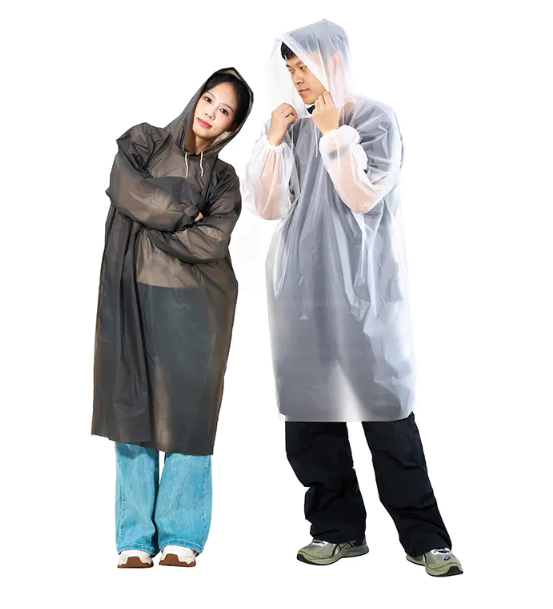
Waterproof performance in thin materials
Thin material does not automatically mean poor protection. A lightweight eco-friendly raincoat achieves waterproofing through material integrity, not thickness alone.
EVA and PEVA are inherently waterproof. They do not require a separate coating or membrane. A lightweight eco-friendly raincoat made from these materials blocks water at the molecular level. The sheet itself is the barrier.
Seam construction matters more than material thickness. A lightweight eco-friendly raincoat with heat-sealed seams prevents leakage through stitch holes. Taped seams are the industry standard.
Water column rating measures waterproof pressure. A basic lightweight eco-friendly raincoat may rate 3,000mm. Higher end versions reach 10,000mm. For comparison, heavy rain exerts about 2,000mm of pressure.
Recyclability and material lifecycle
Environmental claims require scrutiny. A lightweight eco-friendly raincoat should be evaluated on full lifecycle impact.
EVA and PEVA can be recycled in facilities that accept #7 plastics. A lightweight eco-friendly raincoat marked with recycling symbol 7 is technically recyclable. Local programs vary widely in what they accept.
Material reduction is another environmental factor. A lightweight eco-friendly raincoat uses less raw material per garment than thick PVC alternatives. Less material means less mass to process at end of life.
Some manufacturers offer take-back programs. A lightweight eco-friendly raincoat returned to the producer enters a closed-loop recycling stream. This is preferable to municipal sorting.
Portability benefits in daily life
The practical advantage of a lightweight eco-friendly raincoat is carriage convenience. A garment that weighs 100 grams changes user behavior.
Pocket storage is feasible. A folded lightweight eco-friendly raincoat slips into a backpack side pocket or laptop sleeve. Some models stuff into an integrated pouch the size of a smartphone.
Bag compatibility improves. A lightweight eco-friendly raincoat does not compete for space with lunch, documents, or gym clothes. It occupies the margin of existing bags.
Multiple unit carriage becomes possible. Carrying two or three lightweight eco-friendly raincoat garments allows household members or group travelers to each have their own.
Comparison with traditional heavy rainwear
Thick PVC raincoats have legitimate uses. A lightweight eco-friendly raincoat serves a different market segment.
Heavy rainwear offers superior abrasion resistance. A lightweight eco-friendly raincoat tears more easily when dragged against concrete or sharp edges. For construction workers, thick PVC remains appropriate.
Thermal properties differ. A lightweight eco-friendly raincoat provides minimal insulation. Heavy rubberized coats trap body heat. In cold conditions, the heavy coat keeps the wearer warmer.
Durability cycles vary. A lightweight eco-friendly raincoat may last two to three seasons of occasional use. A thick PVC coat can survive five years of daily work wear.
Cost per use calculation depends on frequency. A lightweight eco-friendly raincoat at twenty dollars used ten times costs two dollars per wear. A heavy coat at fifty dollars used two hundred times costs twenty-five cents per wear.
Selecting appropriate thickness
Material thickness is measured in microns or millimeters. A lightweight eco-friendly raincoat typically ranges from 0.08mm to 0.15mm.
Thinner versions around 0.08mm are single-use or emergency garments. A lightweight eco-friendly raincoat at this thickness tears easily but packs extremely small.
Mid-range at 0.12mm balances durability and portability. A lightweight eco-friendly raincoat at this thickness survives multiple outings with careful handling.
Thicker versions approach 0.20mm. A lightweight eco-friendly raincoat at this level approaches traditional rainwear durability while maintaining most portability advantages.
When lightweight makes sense
A lightweight eco-friendly raincoat is appropriate for urban commuting, travel, and outdoor events. Users who need rain protection occasionally benefit most.
For daily outdoor work in demanding conditions, traditional materials remain suitable. For everyone else, the lightweight eco-friendly raincoat category offers a practical balance of protection and convenience that did not exist a decade ago. The material science has matured enough to recommend without hesitation.
