
 English
 Español
 Deutsch
Rain protection becomes less straightforward when clothing underneath changes from a T-shirt to a winter jacket, fleece, or work uniform. A close-fitting rain shell can become restrictive as layers increase, particularly during outdoor work that involves frequent arm movement. The Loose Raincoat category addresses that practical gap by leaving additional room between the outer garment and the body.
Extra Room Helps Accommodate Different Clothing Layers
Rainwear used for outdoor work is rarely worn in isolation. Seasonal conditions may require several layers underneath, and the outer garment needs to cover them without pulling tightly around the shoulders or chest.
A loose-fitting cape-style raincoat takes a different approach from a fitted jacket. Its broader body can sit over existing clothing without requiring the wearer to size the rain garment around the thickest layer they expect to use.
This makes the Loose Raincoat particularly relevant to applications where the same rainwear may be used across changing seasons. Workers can add or remove inner layers without necessarily changing the outer rain garment.
The square-shaped construction of the thickened cape model also creates a relatively open body area. Rather than following the exact contours of the wearer, the garment forms an outer protective layer around the clothing underneath.
Arm Movement Is Easier When The Outer Layer Has Space
Outdoor work often involves reaching, bending, carrying, or handling equipment. Restrictive sleeves can become noticeable when the wearer repeatedly extends their arms or works above waist level.
A cape-style rain garment leaves more room around the upper body and arms. The fabric can move with the wearer instead of relying on a close sleeve fit to maintain coverage.
For a Loose Raincoat, that difference matters in practical work settings. Agricultural workers may need to handle tools, maintenance personnel may reach around equipment, and outdoor service staff may repeatedly move between vehicles and work areas.
The garment still needs to remain positioned correctly during movement. A loose silhouette should provide freedom without becoming difficult to control, especially when the wearer is walking against wind or carrying an object.
A Cape Shape Changes How Rainwear Covers Clothing
Traditional rain jackets divide coverage into sleeves, torso panels, and a fitted waist or hem. A square-shaped cape distributes the outer material more broadly across the body.
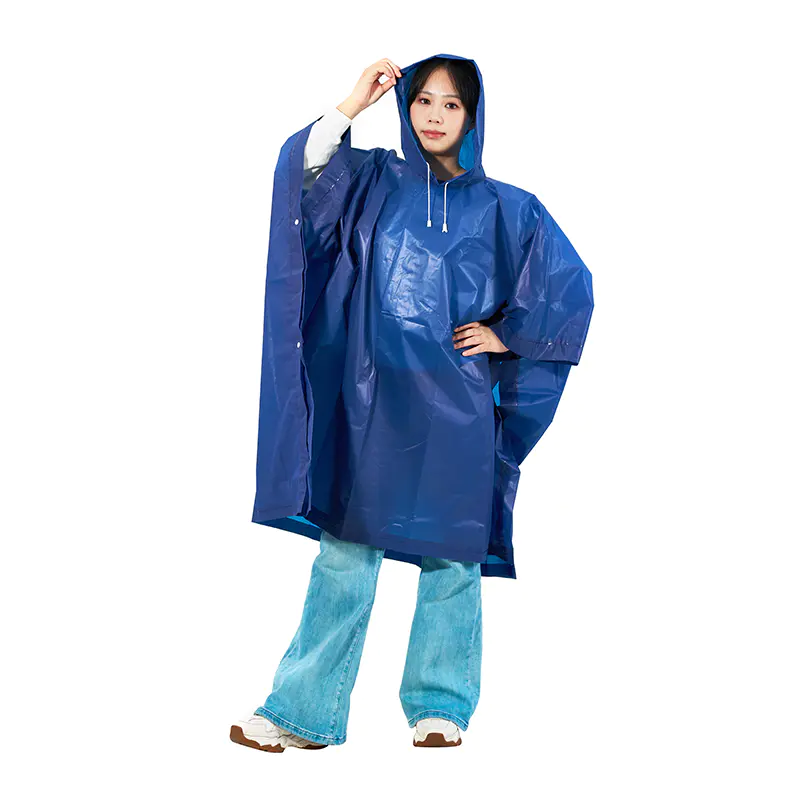
The thickened loose-fitting cape model uses an enlarged silhouette intended to cover the wearer and clothing underneath. Its construction is suited to situations where coverage needs to extend beyond the immediate body outline.
This approach also makes the Loose Raincoat useful for wearing over work uniforms, casual clothing, or other protective layers. The outer garment does not need to replicate the shape of every layer underneath.
The resulting fit is deliberately relaxed rather than tailored. That distinction is one of the main reasons loose rainwear remains relevant for practical outdoor applications.
Thickness Matters When Rainwear Needs More Structure
A lightweight emergency poncho and a thickened rain garment serve different purposes. Very thin material can be easy to pack, but a heavier construction can provide a more substantial outer layer for repeated use.
The thickened construction used in this Loose Raincoat model gives the garment a more substantial feel than disposable rain covers. Material thickness also affects how the garment hangs over the body and how it behaves during movement.
For repeated outdoor use, durability depends on more than thickness alone. Seam construction, material quality, fastening points, and resistance to abrasion all influence service life. A thick fabric can still require reinforcement in areas that experience repeated stress.
Loose Rainwear Fits Several Work Environments
The relaxed shape of the Loose Raincoat makes it adaptable to situations where workers wear different uniforms or clothing underneath. It can serve as an outer rain layer without requiring a precise body fit for every user.
This is useful in workplaces where rainwear is issued as shared protective clothing. Instead of stocking many fitted sizes around every possible combination of uniform and seasonal layers, a looser garment can accommodate a wider range of clothing configurations.
Outdoor logistics, agriculture, construction support, municipal maintenance, roadside service, and other weather-exposed jobs can involve sudden changes in working conditions. A rain garment that can be pulled over existing clothing provides a straightforward response when rain begins during a shift.
Storage And Distribution Also Affect Rainwear Use
Loose rainwear has another practical advantage in workplaces where garments need to be stored near entrances or distributed to staff. A simple cape form can be easy to identify and put on when weather conditions change.
The same characteristic can be useful for temporary outdoor operations. Event crews, transport staff, maintenance teams, and seasonal workers may need rain protection without changing their existing work clothing.
The Loose Raincoat therefore occupies a useful position between fitted waterproof jackets and simple disposable covers. Its value comes from the additional space around the body, the ability to accommodate clothing layers, and the freedom of movement provided by a relaxed silhouette.
As outdoor workwear continues to serve more variable conditions, loose rain protection remains relevant where clothing underneath cannot be standardized. The emphasis is less on creating a close-fitting shell and more on providing sufficient coverage without restricting the movements required during the working day.
